
Rapid Drug Screening vs LC-MS/MS Confirmation: What a "Positive" Means
5 min read
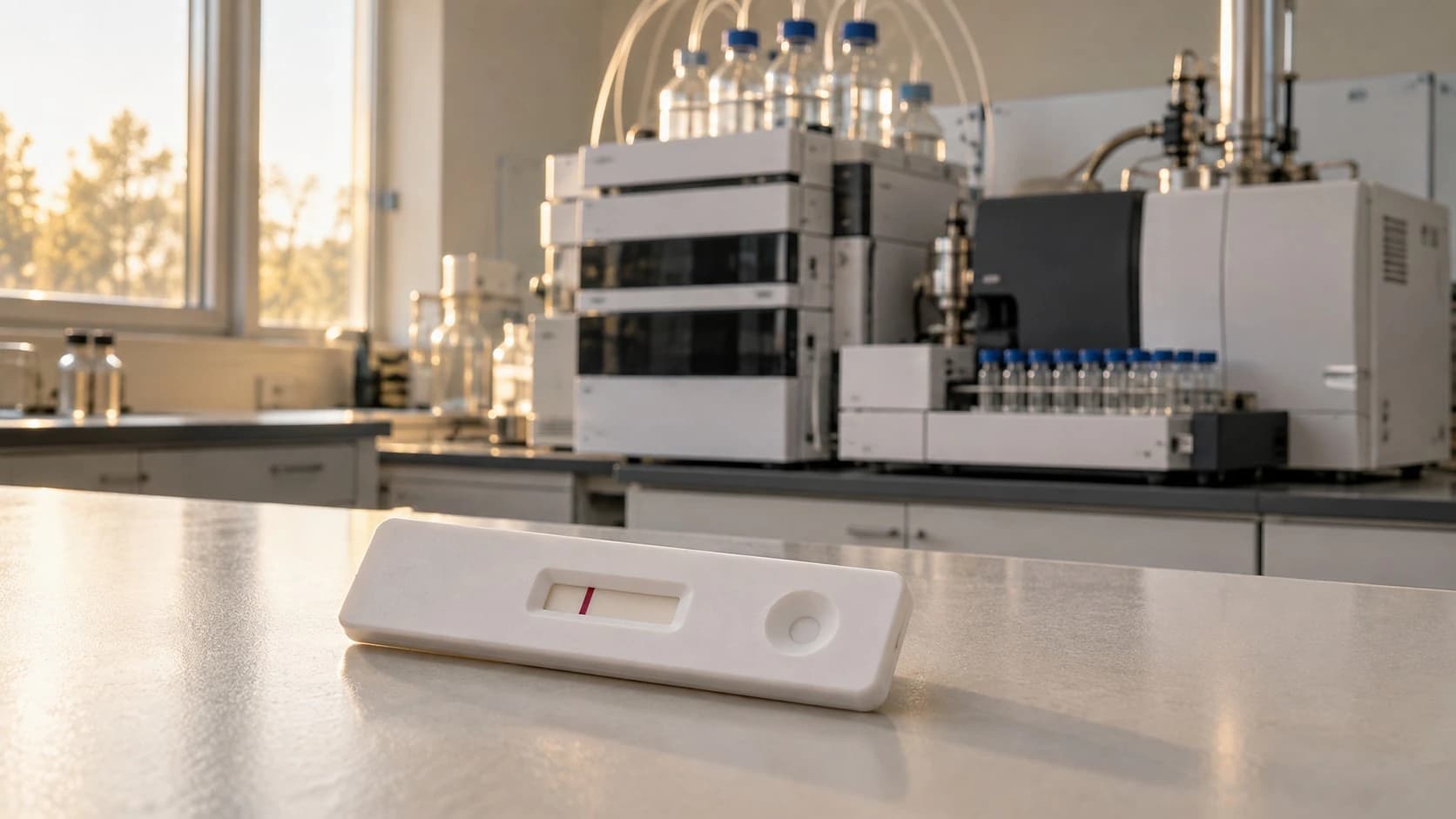
A rapid on-site test and a laboratory confirmation answer different questions. Before acting on a result, or commissioning a laboratory, here is what separates the two.
A site supervisor runs a rapid test and a line appears. Five minutes later, someone has to decide what that line means: send the person home, start a disciplinary process, or wait.
For organisations that commission drug testing, this is the moment where most mistakes are made. Rapid screening and laboratory confirmation are often seen as two different tests, but they are not alternatives to choose between: they are two sequential stages of one process, each answering a different question. Treating a rapid screen result as the final conclusion is a common starting point for disputes.
Two stages, two questions
Drug testing programmes worldwide are built on a two-stage model: initial screening, then confirmation. The US Mandatory Guidelines for Federal Workplace Drug Testing Programs define the two stages most clearly:
An initial (screening) test is "an analysis used to differentiate negative specimens from those requiring further testing".
A confirmatory test is "a second analytical procedure performed on a separate aliquot of a specimen to identify and quantify a specific drug or drug metabolite", that is, a second analysis run on a separate portion of the same sample.
Note how the two divide the work. The rapid screen does not pinpoint the specific substance. Its job is to rule out negative samples quickly and pass suspect samples on to the next stage for testing. Identification and quantification, meaning which substance and how much, belong to the confirmation stage.
Why a rapid screen is not a result
Rapid screening kits in this category work on an immunoassay principle: antibodies bind to a target drug class, and a coloured line shows whether that binding crossed a set concentration threshold, known as the cut-off. It is fast, convenient and needs no instrument, which is exactly what a front-line check needs. But antibodies recognise a whole class of molecules, not one specific compound, so structurally similar substances, including some legitimate medications, can produce a positive line. This is why a positive rapid screen is, in professional terms, a presumptive positive, not a confirmed finding.
Confirmation by mass spectrometry uses an entirely different technique. Liquid chromatography separates the compounds in the sample; tandem mass spectrometry (LC-MS/MS) then identifies each one by its molecular signature and measures its concentration. The report names the substance and, where applicable, its metabolite (the compound the body converts a drug into after use), with a number attached.
The international consensus in hair testing makes this a firm rule. Section 4.2 of the Society of Hair Testing's 2021 consensus states: "All presumptively positive screening tests must be confirmed using mass spectrometry applying internationally accepted identification criteria"; section 5.3 adds that confirmation methods "should include the determination of the parent drug and metabolite(s), where applicable". The metabolite point matters more than it first appears. Identifying certain metabolites is how a laboratory distinguishes actual consumption from external contamination of the hair, which is the objection most often raised against a hair result.
Rapid screening and confirmation compared
Rapid on-site screen | Laboratory LC-MS/MS confirmation | |
|---|---|---|
Question it answers | Does this sample need further testing? | Which substance is present, and at what concentration? |
Output | Negative, or presumptive positive for a drug class | Identified compound (and metabolite where applicable), quantified |
What it targets | Drug class, via antibody binding | Specific molecule, via mass spectrometry |
Time | About 5 minutes on site | Roughly 1–3 working days after the laboratory receives the sample |
Where it fits | Front-line screening, first-pass sorting, rapid response | Any decision that carries consequences: employment action, monitoring programmes, disputes, evidence |
Neither stage replaces the other. A programme that only screens will act on presumptive results, which carries compliance risk; a programme that only confirms will lengthen turnaround and add unnecessary cost for the majority of samples that are negative. The point of the two-stage model is to use each where it is strong.
How the two stages work at RID
RID's testing service is organised around this model. Hair and urine rapid test kits are designed for on-site screening, with a result in about 5 minutes after sample loading, and are intended for workplace front-line checks and institutional screening. Laboratory confirmation of hair samples is performed by LC-MS/MS, with a report issued roughly 1–3 working days after the laboratory receives the sample. The confirmation panel spans 11 substance classes, covering hundreds of substances, including novel psychoactive substances and the etomidate class.
The laboratory is CNAS-accredited (registration L22562) to ISO/IEC 17025:2017, and its methods have been checked through national-level proficiency testing schemes. Detection windows, sample requirements and reporting timelines follow RID's confirmed documentation for each case.
Four things to specify before you commission testing
Most procurement problems in this area come from not confirming, in writing, how the two stages connect. Settle the four points below and write what you agree into the testing contract; that avoids most of the risk:
1. Is every presumptive positive confirmed by mass spectrometry? Does the laboratory confirm automatically, or only when you request it? If confirmation is optional, agree at the commissioning stage who triggers it and who bears the cost; that agreement directly determines how much weight the final report carries.
2. Does the confirmation report name the compound and its metabolite, with concentrations? A report that says "positive for amphetamines" is only a screening-level conclusion. A confirmation report should identify the specific substance and quantify it.
3. What cut-offs are applied, and to what? For hair, the consensus cut-offs apply to segments no longer than 3 cm; longer segments dilute the concentration, and interpretation must fully account for that dilution. Establish which cut-off standard the laboratory applies and how it calculates and handles longer hair segments.
4. Does the accreditation scope cover the confirmation method and sample type you are commissioning? Accreditation is granted for specific methods on specific sample types (hair, urine and so on). Ask for the scope document rather than the certificate alone.
A practical rule
Use the rapid screen to decide who needs further testing. Use the confirmed result as the formal basis for any action concerning that person. If you are preparing a workplace drug-testing plan, a personnel monitoring programme or the testing specification for a tender, talk to us about a testing requirement and we can help review it against the two-stage model.